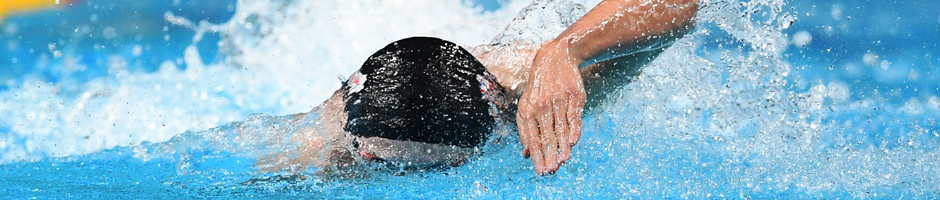

Hannah Miley, Commonwealth 400m medley champion for Scotland this summer past, will warm-up for the defence of her world short-course crown in Doha next month at the new Aquatics Centre in Aberdeen this weekend.
The first stage of the Scottish Grand Prix will be held at the Sports Village from Friday until Sunday under the guidance of the City of Aberdeen Swimming Team (COAST). The series continues in Edinburgh and Glasgow early next year.
The Aberdeen meet might have attracted a bigger British entry had it not clashed with the British University Championships but the likes of Robbie Renwick, Duncan Scott and Andrew McGovern, members of Scotland’s home Games squad in Glasgow this year, will compete.
That Aberdeen now has a £22 million 50m Aquatics Centre makes the Granite City a potential host to international events. All good news for Scotland in a year in which the national team stepped up to do a fine job at a home Games in Glasgow.
Alan Lynn steps up to the head coach role in a year of success for Scotland
Last month also brought news that Scottish Swimming had appointed Alan Lynn as its National Coach. SwimVortex.com caught up with Lynn of late and asked him, among other things, how he saw his role.
How do you see your role – what are the most important aspects of the task?
AL: I see my main priority as working with the coaches to support the improvement of the swimmers through them. Although I will be on deck regularly at programmes around the country and at national team camps etc, I’m not there to second guess or impose my will on the coaches. We have some excellent coaches in Scotland and my recent work in mentoring some of them has been to nudge and challenge, not criticise or browbeat.
I believe that performance is a function of culture and environment, so a lot of time will be invested in assisting the coaches to create optimal conditions for swimmers to improve. I also think that accelerating the learning of coaches will pay dividends, so I’ll be looking at individualised programmes to do this for as many coaches as my capacity will allow.
You take up the role in a fine year for Team Scotland – what are some of the key ways you hope to build on that success?
AL: Recognising that we mustn’t be complacent just because we’ve had a good year is a key message. More of the same won’t be good enough for Rio, Gold Coast or Tokyo & beyond. Our ability to learn from success and failure is another feature of sustained excellence and we have already conducted a thorough audit and review process after the summer. The momentum generated from hosting the Commonwealth Games in Glasgow shouldn’t be underestimated and with the European Championships in Glasgow in 2018, there’s another tangible incentive for swimmers to aspire to. Performance sport is about continuous improvement season after season and looking for ways to get better should always be at the forefront of our minds.
You have home-grown talent and some big names spread across programs beyond Scotland (USA etc included) – how do you work with those athletes, how important is it to stay in touch with their programs and coaches?
AL: My approach will be to regularly communicate with and get feedback from the coaches of all the swimmers, near and far. At home and abroad our swimmers are working with some of the world’s best coaches so I have every faith in their ability to keep doing a great job with the talent they have. Domestic travel is obviously much easier than international journeys, so Performance Director Ally Whike and I will be keeping tabs on the swimmers training abroad through regular contact with them and their coaches via Skype / FaceTime etc.
We will also see them at Meets around the circuit, for example there is a small Scottish group going to the US Winter Nationals in early December where some of our USA based swimmers may be competing.
What role will central HQ/Stirling play in your plans?
AL: Stirling is one of four key performance environments, along with Edinburgh, Glasgow & Aberdeen. Each of these is distinctively different in structure and operation, however collectively they are the powerhouses of Scottish Swimming, accommodating clubs, University programmes and crucially, the support services provided by the sportscotland institute of sport.
Characteristically, each of these environments provides long course training to the programmes based there and those within a reasonable travelling distance. Our national squads will also use each of these performance environments accordingly based on the objectives of the programme, e.g the Youth Development Squad was recently in Aberdeen for an education and training weekend and the same group will be in Stirling from 26-30 December for the traditional post-Christmas training camp.
What’s the meaning of success … if in 8 years you look back and have reason to be happy with a job well done, what would those reasons/achievements be?
AL: I obviously won’t be drawn on specifics like medal targets and so on, there are too many variables attached to what the outcomes of high level sport will be. However we have a clear sense of what we want to achieve in relation to existing benchmarks.
We have been preaching process over product for several years and I think the results of this approach are evident. You get better at swimming by doing the right things over and over, putting in the hard work required to compete at World level.
Read the original article at the Swim Vortex Website


